




By Christina Jameson and Wesley Edmonds, Directors of Workplace, OFS
At WorkX San Francisco 2026, we asked workplace experience leaders from across the country one simple question: What makes the office commute worth it?
Whether the conversation was about budgets, utilization, hybrid work, AI, culture, or real estate strategy, it kept coming back to the same idea: the workplace has to create enough value for employees to choose it and enough value for the business to justify the investment.
What stood out was not one specific answer, but a shift in how workplace leaders are thinking about it as a whole. Here are our biggest takeaways from the conference.
Do more with less, but make it intentional
Budget was a recurring theme, but the focus wasn’t simply on reducing costs. It was about making thoughtful, intentional decisions with the resources available. Francis Aquino, Global Workplace Experience Leader whose workplace experience includes Alo, Netflix, Uber, and Headspace, summed up the pressure clearly: “Budgets are shrinking, but expectations are growing.”
Aquino also emphasized that “culture doesn’t have to be expensive. It has to be intentional.” Creating a stronger workplace experience does not necessarily require more space, amenities, or investment. Employee-led experiences, a creative reuse of space, flexible products that adapt over time, and environments designed for peer-to-peer recognition can strengthen culture while making limited resources go further.
Align the workplace with business strategy
John Lopes, VP of Corporate Real Estate at WSP, reinforced that “your workplace must support the business strategy.” This means that workplace experience decisions, including furniture decisions, cannot happen in isolation from the goals of the organization. If the business is focused on growth, innovation, talent attraction, speed or efficiency, the workplace should be designed to help enable those outcomes. It is our job to help communicate the why behind those designs and solutions. The question is not simply what the space costs, but whether that investment is helping the business get where it wants to go and supporting its long-term strategy.
Lopes also highlighted the hidden cost of waiting. Delays can impact an organization’s profit and loss even when they never appear as a project line item. His reminder that “the workplace is not just a cost center. It is a value signal” reframes the conversation from what space costs to what it enables. The “do nothing” option is never free. It can transfer costs elsewhere through lost productivity, employee experience, attraction and retention, or the inability to adapt as the business changes. The opportunity for workplace leaders is to connect workplace decisions to measurable business priorities and make their value visible.
Jenn LaBelle, Director of Workplace Environment and Workplace Strategy at Etsy, brought that thinking into the design process: “Don’t pour the concrete until you pilot or experience it.” Her point was to avoid locking capital into assumptions that have not yet been validated. Pilot the idea, observe how people use it, listen and learn before committing resources to a fixed solution.
The strongest workplace decisions begin with a business problem, not a predetermined space solution. Employee feedback, pilots, and iteration help validate the investment, but the business need remains the anchor. If a company needs teams to innovate faster, the workplace should make it easier for people to come together and share ideas. If it is competing for talent, the experience should help people feel valued and give them reasons to choose the office. If it is growing quickly, the space and furniture should be able to adapt without requiring another major investment. That is what it means for the workplace to support the business strategy. The goal is not simply to spend less. It is to invest in a workplace that helps the business accomplish what it is trying to do today while remaining ready for what it needs to do tomorrow.
We have enough data. We need better insights.
Utilization, occupancy, square footage, and attendance have become part of nearly every workplace decision. But a recurring challenge was clear: many companies are drowning in data but starving for insight. Collecting data and understanding what it means are two very different things.
David Wilson, VP of Workplace Experience and Facilities at Acuity, challenged workplace teams to move beyond midweek peak utilization and use data to tell a broader business story. Consider a headquarters designed to enable innovation. Occupancy alone can tell us whether a space is being used, but not how it is being used or whether it is achieving its intended purpose. By pairing utilization data with AI-generated meeting insights, employee feedback surveys and other signals, workplace teams can build a more holistic picture of performance. Wilson used the example of a room designed to support innovation: if utilization is high, but meeting insights show that only a few people are contributing to the conversation, is the space really supporting innovation? The opportunity is to move beyond measuring whether people show up and begin measuring whether the workplace is enabling the behaviors and outcomes the business needs.
This could allow organizations to measure something more meaningful than how full a building is: whether the workplace is enabling the outcome it was designed to support. The question is no longer simply, “Are people using the space?” It is, “What is happening because they are using it?”
AI is making human skills more valuable
Sharad Aggarwal of Google Cloud added another layer with his session on redefining work in the age of AI. His statement that “disruption isn’t linear” may be one of the most important ideas for workplace leaders right now.
As AI takes on more administrative work, Aggarwal pointed to the human skills that become even more valuable: judgment, accountability, negotiation, cross-functional translation, and exception handling. That creates a bigger workplace question. As technology handles more routine work from almost anywhere, what is the physical workplace uniquely positioned to support?
The office can become the place where people solve complex problems together, build trust, learn from one another, challenge assumptions, and make decisions that do not fit neatly into an algorithm. Those are harder to measure than attendance, but much closer to the value organizations need from their people.
Valerie Jardon, Managing Director of Strategy at IA Interior Architects, reinforced a shift from measuring the productivity of “how many” toward understanding “how human.” When people represent such a significant investment relative to real estate, the bigger risk is bringing them into a workplace that does not help them do anything better once they get there.
As AI changes the value of human work, workplace success should be measured less by whether people show up and more by what becomes possible because they came together.
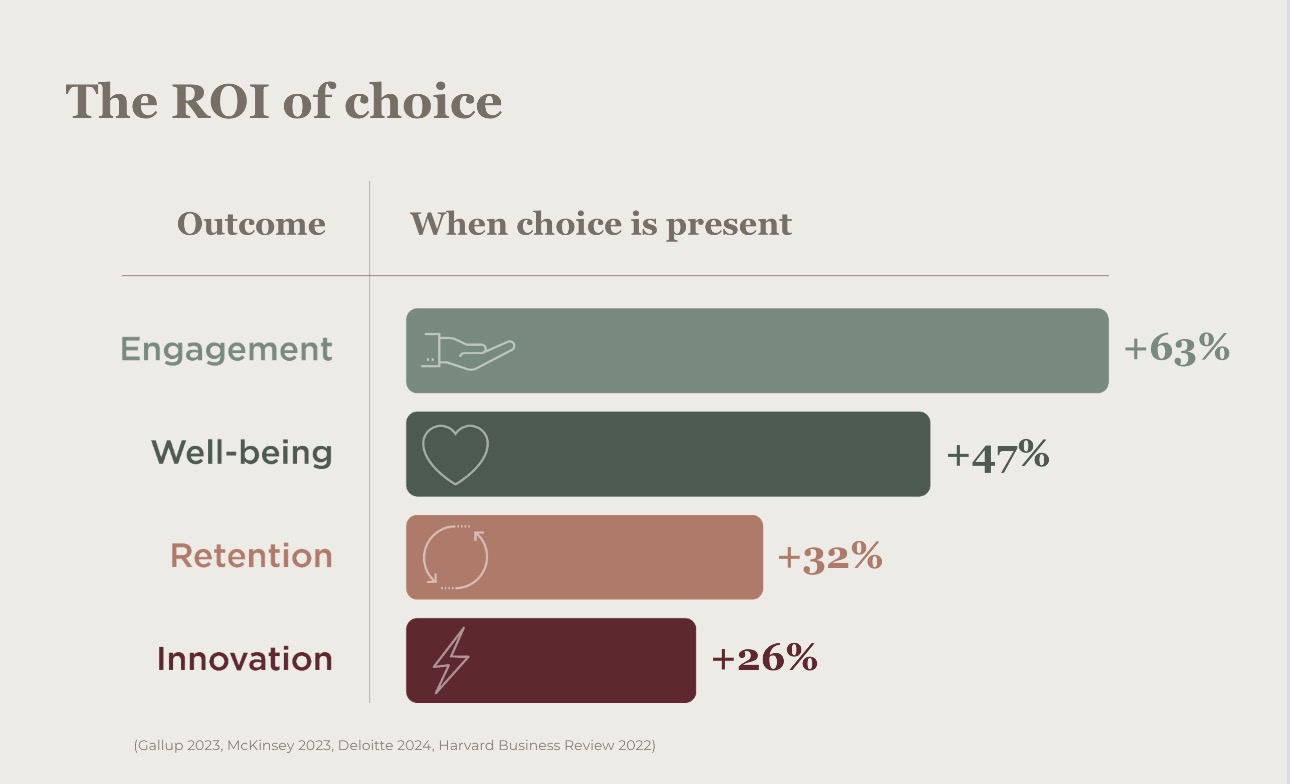
Choice is a workplace strategy
If the workplace is expected to support these distinctly human skills, it must support the different ways people work. For some, critical decision-making happens during collaborative sessions, while for others, it happens during moments of deep focus.
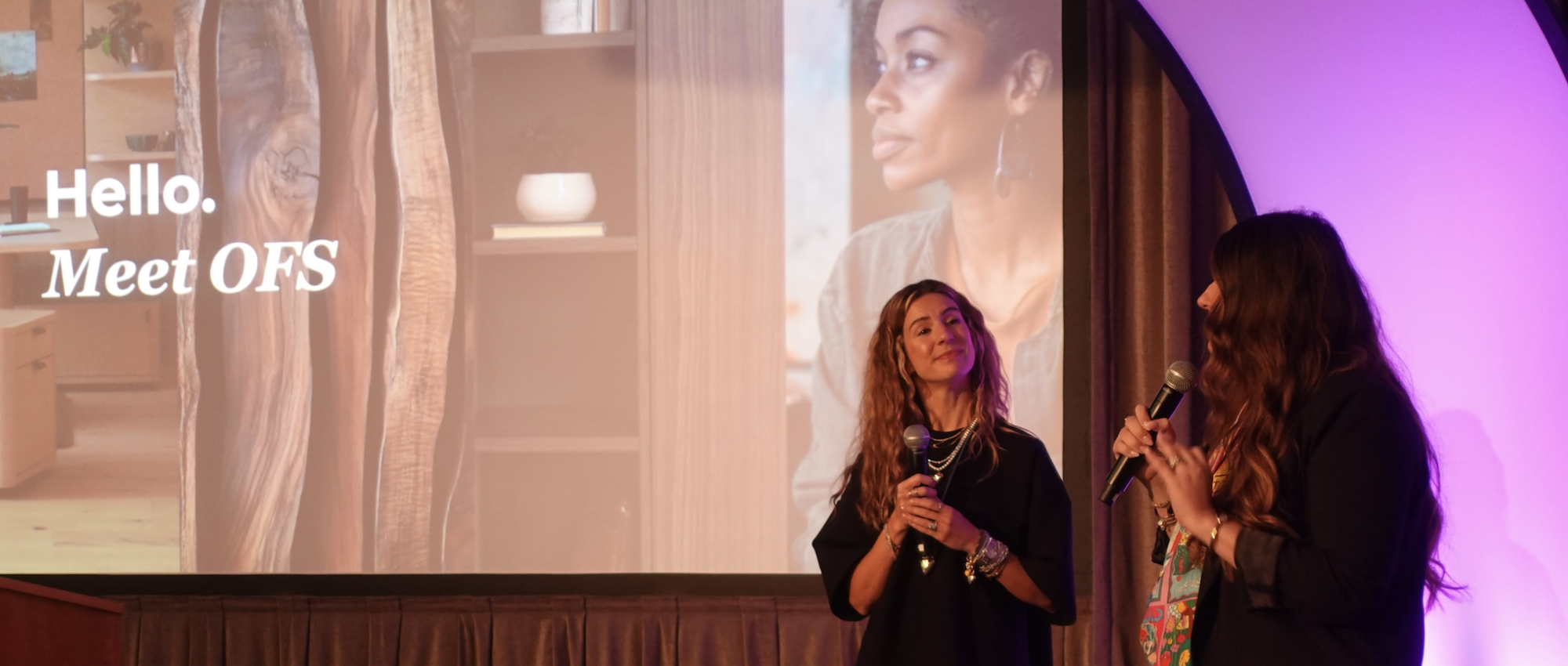
We had the opportunity to share some of our Power of Choice research on stage, and it was validating to hear workplace leaders such as Raymond Chan with NVIDIA echo the same sentiments. He is finding that employees are craving spaces that allow them to work differently based on the task at hand, rather than having their workspace dictate how they work.
Chirag Kadiwar, Senior Director and Global Head of Workplace at Meta, shared that employees returned from the pandemic asking for more focus spaces within an environment historically designed around openness and collaboration. Flexible solutions that allow for choice have helped Meta adapt while still supporting the goal to “bring the buzz back in the office.”
The opportunity is to create environments that support different types of work throughout the day without forcing everyone into the same experience. Collaboration matters, but so do concentration, privacy, learning, and connection. A workplace that earns the commute must support all of them while creating the conditions for the distinctly human skills AI cannot replace.
Conclusion
The commute comes at a high cost. It costs employees time, energy, and flexibility. The office must give something meaningful back. That does not mean every day needs an event, an amenity or a packed room. It means the workplace needs a clear reason to exist within the way work happens now.
People continue to be the primary reason employees choose the workplace. The organizations that understand that will stop treating occupancy as the goal and start treating the workplace as a tool for performance, connection, and human potential.